

It usually starts with a screenshot.
Someone posts a development map in a neighborhood group.
A property owner hears that commercial construction is coming.
Someone says a road is being widened.
Then my phone rings.
“Ashley, they are building behind my house.”
“Have you heard what is going in over here?”
“Is this going to hurt my property value?”
“Should we sell?”
My answer is usually some version of this:
Do not make a real estate decision yet. Let’s find out what is actually happening.
That is very different from ignoring it.
If there is development near your DFW home, the first step is understanding what has actually been proposed before making assumptions about property value or deciding whether to sell.
Depending on the project and jurisdiction, there may be public meetings, hearings, notices, documents, or opportunities for property owners to learn more or provide input.
So I do not want you doing nothing.
I want you doing the right things in the right order.
What Should You Do When You Hear About Development Near Your Home?
Start by separating information from reaction.
A screenshot on social media may be accurate.
It may also be outdated, incomplete, misunderstood, or missing important context.
Before we start discussing whether you should sell your house, I want to know:
What exactly is proposed?
Where exactly is it?
Who is proposing it?
What stage is it in?
What approvals have occurred?
Are additional approvals needed?
Are there public documents available?
Is there a hearing or meeting scheduled?
What does the current plan actually show?
Those are much better questions than:
“Is my house going to lose value?”
We are not ready for that question yet.
Where Should You Verify a Proposed Development?
I want to start with official sources whenever possible.
Depending on the project, that could include a city planning department, zoning commission, city council agenda, transportation agency, county, public meeting documents, or another government entity responsible for the project.
The appropriate source depends on what is being proposed.
This matters because the word proposed can cover a lot of ground.
A concept someone is discussing is different from a formal application.
An application is different from an approval.
An approved project is different from active construction.
We need to know which one we are dealing with.
Should You Wait Before Paying Attention?
No.
This is where I would make an important distinction.
I do not want homeowners making an immediate decision to sell because they heard about a development.
But I also do not want them assuming there is no reason to pay attention until construction begins.
Depending on the project, there may be public processes occurring much earlier.
Questions about legal rights, a zoning protest, land-use law, governmental action, or what you should formally submit belong with an attorney or the appropriate government authority.
I am not going to give legal advice.
What I can do is help you understand the real estate question and identify information we need before discussing a potential sale.
Will New Development Lower Your Property Value?
I cannot answer that from a development map.
And I would be cautious of anyone who immediately does.
A nearby change could potentially affect how future buyers evaluate a property, but whether there is a measurable effect on market value is a different question.
The type of development matters.
The location matters.
Distance matters.
Visibility may matter.
Access may matter.
Traffic patterns may matter.
Existing and proposed land use may matter.
The individual property matters.
And most importantly, actual market evidence matters.
Appraisers are expected to consider relevant neighborhood characteristics, adjoining property uses, and external influences when those factors affect marketability or value.
That is a much more disciplined approach than declaring every development good or bad.
What If the Development Changes Your View?
Now we have a more property-specific question.
If you bought a home because it backs to open land and a proposed project could change that physical setting, I understand why you would want more information.
But even then, I am not going to immediately tell you to sell.
First I want to understand the actual plan.
How close is the proposed project?
What would be located nearest your property?
Are buffers shown?
What does the current site plan show?
Is the project approved?
What timeline has the responsible authority or developer publicly identified?
Then we can look at your real estate situation.
Are you already considering moving?
How long were you planning to stay?
What is happening in your particular housing market?
What properties would your home compete against if you sold?
Those questions give us something useful to evaluate.
What If a Road Project Is Planned Near Your Home?
Road projects deserve the same discipline.
Do not assume that “road construction” tells us enough.
We need to know what project is actually planned and which agency is responsible for it.
Is the road being widened?
Is access changing?
Where is the proposed right-of-way?
What is the current project stage?
What timeline has the responsible agency published?
If you have questions involving easements, condemnation, property rights, compensation, or other legal matters, those belong with an attorney or the appropriate qualified professional.
My lane is helping you evaluate your real estate options once we understand the facts relevant to your property.
Should You Sell Before Construction Starts?
Maybe.
Maybe not.
That is not a satisfying internet answer, but it is a responsible real estate answer.
I would want to know why you are considering selling in the first place.
If you already planned to move, new information about nearby development might become one factor in a larger timing conversation.
If you had no intention of moving until you saw a social media post yesterday, I am probably going to ask you to slow down.
Selling a house is a significant decision.
There are transaction costs.
Moving costs.
Timing considerations.
Market conditions.
And whatever comes next for you.
I do not want a rumor making that decision for you.
What If You Want to Stay?
Then staying may absolutely remain one of the options you evaluate.
Learning about a proposed project does not automatically create a real estate problem that needs to be solved.
You may decide the project does not materially change how you feel about your home.
You may decide you want more information.
You may decide to follow the public process.
You may decide to consult an attorney about a question outside my expertise.
Or you may eventually decide that moving makes sense.
The point is that the decision comes after the information.
Not before it.
What Is My Role as Your Realtor?
My job is not to turn development news into a listing appointment.
That would be easy.
It would also be the wrong approach.
If you call me concerned about something happening near your property, I want to help separate what we know from what we do not know.
I can help research relevant real estate information.
I can help evaluate current market activity and comparable properties.
I can help you think through timing if selling is something you are genuinely considering.
I can help identify questions that need to go to the city, county, transportation authority, attorney, appraiser, engineer, or another qualified professional.
And I can tell you when I do not know.
That matters too.
Can a Realtor Predict How Development Will Affect Your Home?
No.
I can look at available real estate data.
I can study market response.
I can look for relevant comparable situations when they exist.
I can discuss how buyers are currently responding to your market and what your property would compete against if listed.
But I cannot promise that a proposed development will increase your value.
I cannot promise it will decrease your value.
And I cannot predict exactly how buyers several years from now will respond to something that may not even be built in its current proposed form.
No predictions.
No panic.
Better information.
What My Clients Say
Ashley Plazza shared:
“Ashley was amazing and helped us find our dream home in Corinth Texas! She was so easy to work with and I really appreciate her openness and honesty when helping us shop for a home. We got everything we could’ve wanted in a home!”
Openness and honesty are particularly important when there is uncertainty.
Sometimes the most useful answer I can give a client is:
We do not know enough yet. Let’s find out.
Heard About Development Near Your DFW Home?
Before you put a sign in the yard, call me.
Not because I am automatically going to tell you to sell.
I may tell you the opposite.
Let’s identify what has actually been proposed, what information is available, what questions still need answers, and whether any of it changes your real estate plans.
If the issue involves legal rights, zoning law, engineering, property rights, governmental action, or another area outside my expertise, we will identify the appropriate professional or governmental source for those questions.
Then we can talk about the real estate decision.
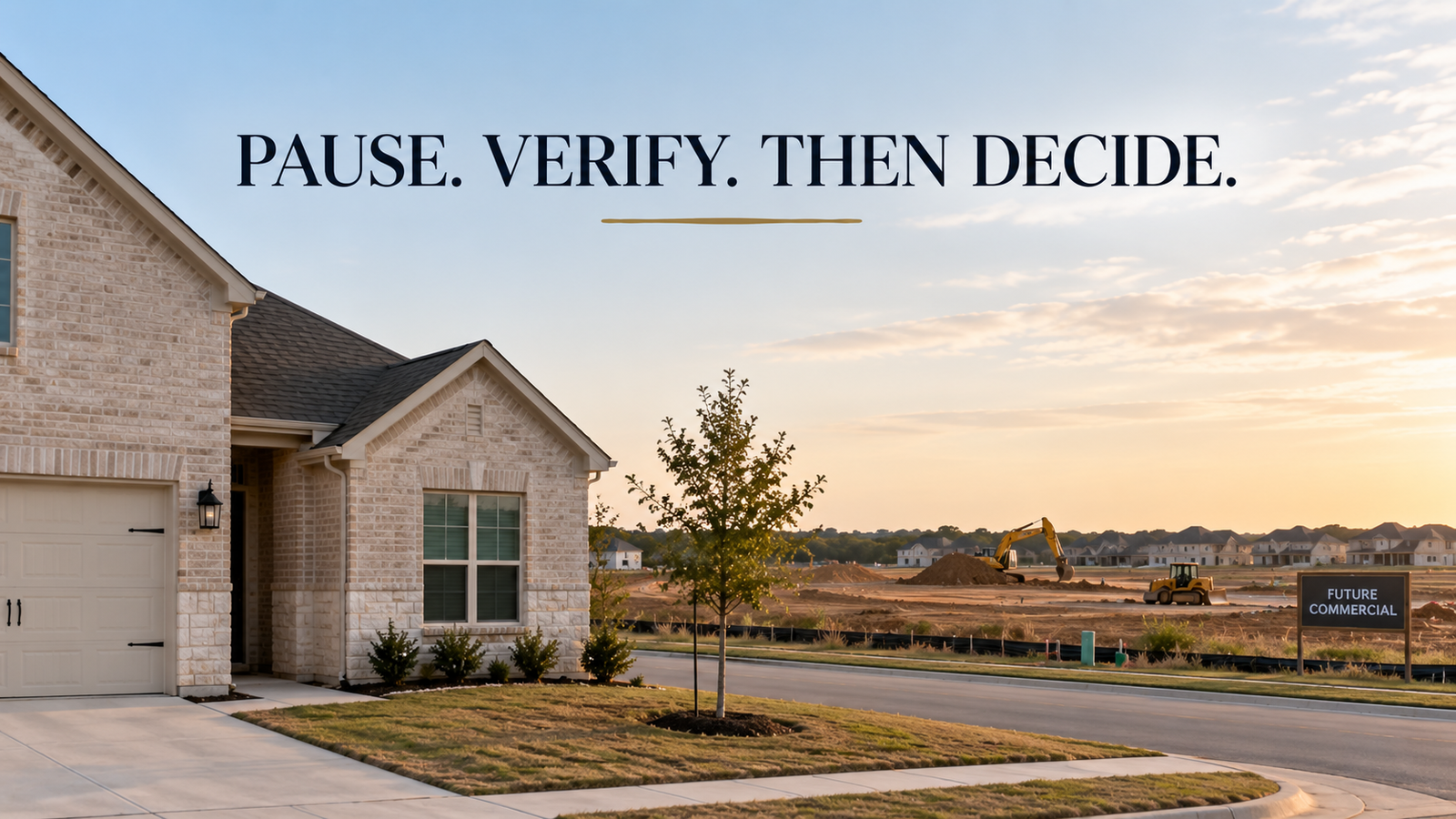
Pause. Verify. Then decide.
That is a much better order.
Visit HART Realty Team or connect with me at @AshleyHartRealtor.